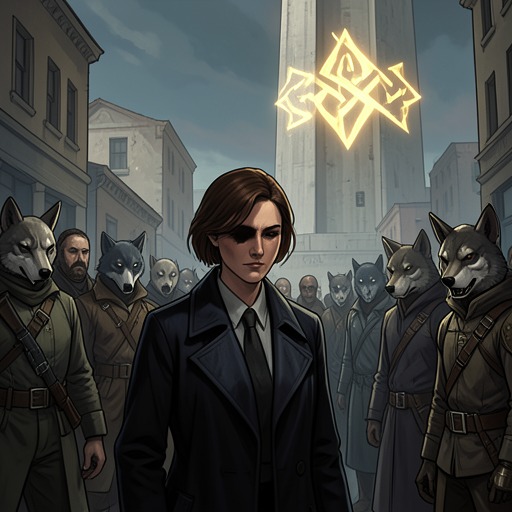
The Girl Who Cried Werewolf Film Announcement
Of Fates & Fables (The Complete Series)The Girl Who Cried Werewolf Film Announcement is the decisive cross-media turning point in Romy’s public life: the story that began as social-media controversy and became a book is announced as a feature film. Its trailer makes Romy’s experiences visible to a mass audience, promising celebrity, financial change, and a new struggle over who may represent her life.
From Online Attention to a Book
Romy’s film opportunity grows out of a longer chain of public self-presentation. After posting videos and commentary about werewolves, she sees her Instagram following recover and then surpass its original size, a reversal that turns hostile attention into measurable audience power. She also weaponizes the language of book culture and celebrity fandom, posting that an apparently attractive stranger might be a werewolf and joking that Jason Momoa could not possess mortal DNA. The post links her recurring “The Girl Who Cried Werewolf” label with hashtags such as “#BookBoyfriendsAreReal,” converting suspicion, humor, and platform visibility into a recognizable public persona.
The next step is literary rather than cinematic. Romy is told that a sample from the book she is writing is brilliant and that an agent is interested in meeting her. This response gives her more than attention: it supplies professional validation and a possible route into the publishing industry. The film announcement therefore does not appear as an isolated surprise. It is the commercial extension of a story already moving through Instagram, viral discourse, and manuscript form.
The Trailer Reveal
The announcement arrives through a television trailer watched by Romy and her friends. The words are taken from the prologue of Romy’s book, but the voice belongs to an A-list celebrity, a disorienting substitution that makes her real life sound as though it has already been absorbed into entertainment. The trailer presents several compressed images: red hair in an alley, a large wolf baring its teeth, and a couple facing one another amid unmistakable sexual tension. The sequence reduces the book’s world to instantly legible promotional signs—danger, the monstrous, and erotic conflict—before the voice-over announces the title and a theatrical release in the fall.
The trailer’s language also reframes Romy’s public label. The prologue declares that “The Girl Who Cried Werewolf” is officially listed across her social-media handles, while insisting that hearing the news is not the same as knowing the truth. Romy claims that the book will reveal how she became entangled with werewolves and makes clear that she is not sorry for telling the story. The film thus inherits a central tension from the book: it promises access to the truth while packaging that truth through celebrity narration, dramatic imagery, and a marketable title.
Rights, Ownership, and Commercial Stakes
The announcement immediately raises questions about ownership rather than simple celebration. Talia steps forward beside Romy to state that any discussion of Romy’s media rights must include financial negotiation and the legal rights Romy will retain. Her intervention prevents the adaptation from being treated as an uncomplicated reward for visibility. The story may have become valuable because of Romy’s labor, but that value creates a new danger: other people may profit from, simplify, or control an account rooted in experiences that Romy actually endured.
This concern is especially sharp because the film turns intimate and dangerous material into a public commodity. The trailer uses the visual grammar of a commercial romance-horror spectacle, while Romy recognizes that the images are recreating her actual life. Talia’s insistence on payment and retained rights gives the moment a practical feminist dimension: authorship is not only the ability to speak, but also the ability to determine the terms under which speech is reproduced and monetized.
Celebration Without Surrender
Romy initially reacts with stunned disbelief, saying that she cannot believe it is really happening. Her reaction carries the weight of years spent managing posts, comments, followers, and trolls who tried to undermine her sense of success. Justice responds with a high five, and Talia treats the announcement as a victory over the people who dismissed or attacked Romy. The film promises that her public position will change dramatically, and Romy acknowledges that once it breaks records, everything may be different.
Yet the scene ends by limiting the meaning of success. Romy embraces Kash and kisses him, expressing the hope that not everything will change because she is happy with her life as it stands. Kash agrees. The announcement therefore produces a double ending: Romy accepts the scale of the opportunity while refusing the assumption that commercial expansion must replace her chosen relationships, pack life, or personal stability. The film opens a new public future, but the final emotional claim belongs to continuity rather than transformation.
Narrative Significance
The event completes a progression from credibility crisis to cultural authority. Romy’s frightening account was once vulnerable to ridicule, hostile comments, and the “girl who cried werewolf” accusation; by the time the trailer appears, the same phrase has become a title, a social-media identity, a book prologue, and a film brand. The insult has not simply disappeared—it has been appropriated and made productive on Romy’s terms.
At the same time, the adaptation preserves the book’s unresolved contradiction between exposure and control. Romy wants the truth heard, yet the truth now passes through agents, celebrity voices, legal negotiations, and visual spectacle. The announcement is consequently both vindication and warning. It confirms that Romy has converted attention into authorship and authorship into cultural reach, while reminding her that every new medium creates another struggle over representation, profit, privacy, and the right to define what her story means.